




aTITLES AND ABSTRACTS
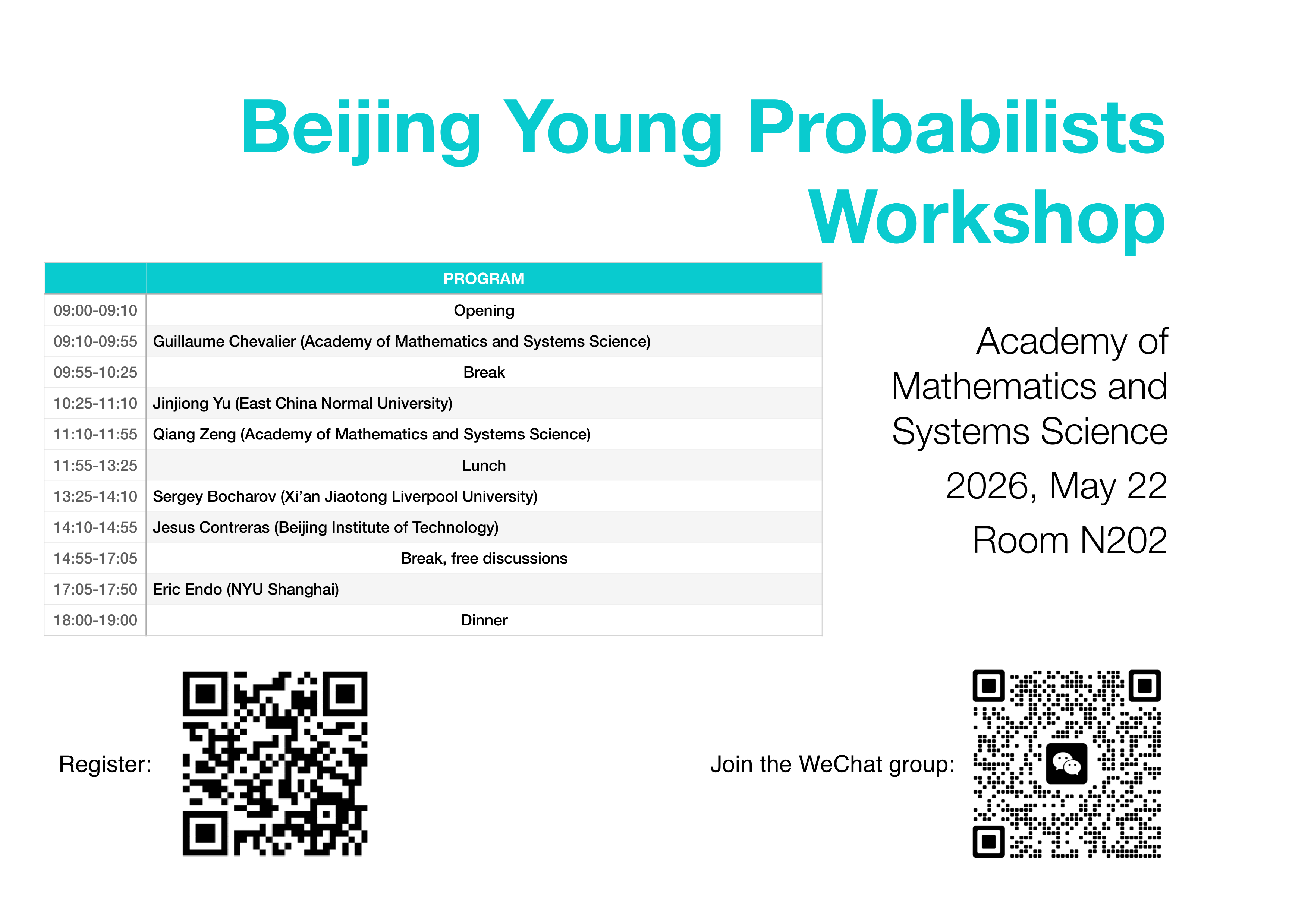
May 22th, Morning Presentations
Nearest neighbour random walks on infinite free product: An asymptotic expansion to all orders for the return probability
In this presentation, we will focus on a nearest-neighbour random walk on the free product of a countable family of finite groups with uniformly bounded cardinality. This presentation is based on an article by S. Lalley [Dyn. & Rand., 2002], in which he presents a method to obtain a first-order asymptotic of the return probability of the considered random walk. We will present an improvement of this method allowing us to obtain an asymptotic expansion to all orders of the return probability.
The critical Volterra measure
We study a class of critical linear stochastic Volterra equations with multiplicative noise, and show that their solutions, viewed as random measures, converge to a universal scaling limit. This limit, called the critical Volterra measure, also arises as the scaling limit of a class of critical disordered pinning point-to-point partition functions. We then give a full characterisation of this measure. Based on joint work with Francesco Caravenna, Ma¨el Laoufi and Ran Wei.
Marginal stability phase transitions near the critical external field of spherical spin glasses
We examine the energy landscape near the global maximum of smooth Gaussian random fields on spheres. A key focus is determining whether the largest eigenvalue of the Hessian is zero—a condition known as marginal stability in physics. In this talk, I will show that the model undergoes (marginal) stability phase transitions across the critical external field corresponding to different levels of replica symmetry breaking in the sense of Parisi, a phenomenon predicted in physics literature for Euclidean random landscape. Time permitting, I will also discuss some new findings on landscape complexity in the presence of an external field. This talk is based on joint works with Hao Xu (Central South University) and Haoran Yang (Peking University).
May 22th, Afternoon Presentations
Split times in a critical Galton-Watson tree: a Brownian excursion approach
A continuous-time Galton-Watson process is a process initiated by a single particle which lives for a random time T ∼ Exp(β) for some parameter β > 0 referred to as the branching rate. Upon death the initial particle gives birth to a random number ξ of new particles, where ξ follows some distribution P(ξ = k) = pk, k ≥ 0 referred to as the offspring distribution. New particles independently of each other and of the past replicate the initial particle’s behaviour. This goes on forever or until there are no particles left in the system. We let Nt be the number of particles in the system alive at time t and Tt the genealogical tree of the process evolved up to time t. We are interested in the special case of such processes when E[ξ] = 1 called the critical case. It is known that in this case the process eventually becomes extinct, but conditioned to survive to time t it shows interesting behaviour in the limit as t →∞. For example, conditional on Nt > 0, the process converges in distribution to an Exponential random variable (this goes back to the works of Kolmogorov and Yaglom). Furthermore, conditional on Nt > 0, the contour function of the tree Tt converges to a Brownian excursion (this goes back to the works of Aldous) and so the Brownian excursion encompasses the genealogical structure of a critical Galton-Watson process.
In this talk we want to show how Poisson-point-process structure of a Brownian excursion (see, for example, “A guided tour through excursions” by Rogers) can be used to recover the limiting joint distribution of split times of k particles sampled uniformly at random from the population in a critical Galton-Watson process conditioned to survive to time t as t →∞.
On some asymptotic results for non-decreasing Markov additive processes
A Markov additive process (MAP) consists on two components, the modulator and the ordinator or additive part. The modulator is a Markov process, and conditionally on it, the ordinator has independent increments. They arise in applications in finance, risk and queueing theory, and can be thought as a generalization of L´evy processes. Recently, under some regularity assumptions of the modulator, several asymptotic results have been proved for the additive part. In this talk, we review first a strong law of large numbers and a central limit theorem in the case in which the ordinator is a semimartingale (Kyprianou-Rivero, 2026) , and afterwards a law of the iterated logarithm and some large deviations results when the ordinator is non-decreasing. This presentation is based on an ongoing work with Victor Rivero (CIMAT, Mexico).
Equivalence of Ensembles: CLT and Local CLT for Gibbs
In this talk, we consider the problem of the equivalence between Grand Canonical Ensemble and Canonical Ensemble. The Grand Canonical Ensemble is the probability measure µ that maximizes the Shannon entropy under the constraint that the average of the energy is fixed. It is known that the distribution has density proportional to e−βH, where H is the Hamiltonian that describes the energy of the system. Canonical ensemble is the conditional distribution obtained by µ under the condition that the sum of the spins SΛ in Λ is fixed equal to N such that µ(SΛ = N) > 0. We study sequences of canonical ensembles such that 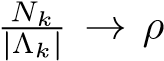 , where ρ > 0 is the density.
The idea of using the Local Central Limit Theorem to study the equivalence between the grand canonical ensemble and the canonical ensemble is classical. In this talk, we revisit this problem in light of recent works concerning the equivalence between the Central Limit Theorem and the Local Central Limit Theorem for long-range potentials.
Joint work with Roberto Fern´andez, Vlad Margarint, and Tong Xuan Nguyen.
附件下载: