


Jiajie Chen
The University of Chicago


Academic workshop · 学术研讨会
流体力学中的非线性偏微分方程研讨会
A focused meeting on analysis, dynamics, and emerging methods for nonlinear partial differential equations in fluid mechanics.
01 · Context
The workshop brings together researchers working on the mathematical analysis of partial differential equations arising in fluid dynamics. It provides a focused forum for presenting recent developments, exchanging ideas, and discussing challenging open problems.
The programme is designed to encourage sustained interaction between established researchers and young mathematicians, with topics ranging from incompressible and compressible flows to kinetic theory, vortex dynamics, free-boundary problems, regularity, singularity formation, and AI-assisted approaches to PDEs.
本次研讨会聚焦流体动力学相关偏微分方程的数学分析,旨在分享最新进展、讨论开放问题,并促进资深学者与青年研究人员之间的深入交流。
02 · Community
The University of Chicago
Academy of Mathematics and Systems Science, CAS
Beijing Normal University
Xiamen University
University of Science and Technology of China
Shanghai Jiao Tong University
Peking University
University of Bath
Duke Kunshan University
The Hong Kong Polytechnic University
Xiangtan University
03 · Beijing time
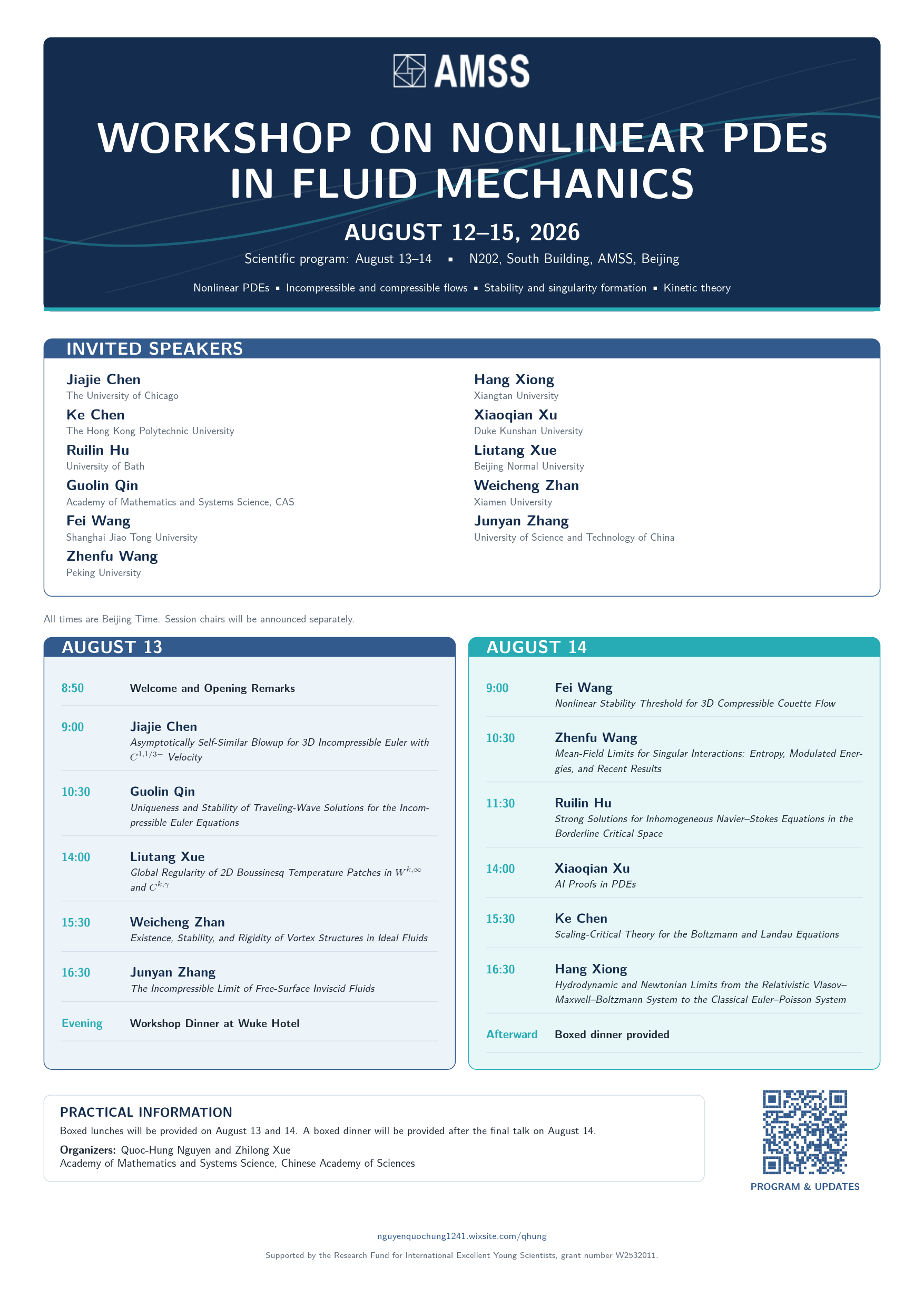
Research talks are 60 minutes including questions.
August 13, 2026
Workshop organizers
Welcome and Opening Remarks
The University of Chicago
Asymptotically Self-Similar Blowup for 3D Incompressible Euler with C1,1/3− Velocity
Coffee break
Academy of Mathematics and Systems Science, CAS
Uniqueness and Stability of Traveling-Wave Solutions for the Incompressible Euler Equations
Lunch break · boxed lunch provided
Beijing Normal University
Global Regularity of 2D Boussinesq Temperature Patches in Wk,∞ and Ck,γ
Coffee break
Xiamen University
Existence, Stability, and Rigidity of Vortex Structures in Ideal Fluids
University of Science and Technology of China
The Incompressible Limit of Free-Surface Inviscid Fluids
Workshop dinner at Wuke Hotel
August 14, 2026
Shanghai Jiao Tong University
Nonlinear Stability Threshold for 3D Compressible Couette Flow
Coffee break
Peking University
Mean-Field Limits for Singular Interactions: Entropy, Modulated Energies, and Recent Results
University of Bath
Strong Solutions for Inhomogeneous Navier–Stokes Equations in the Borderline Critical Space
Lunch break · boxed lunch provided
Duke Kunshan University
AI Proofs in PDEs
Coffee break
The Hong Kong Polytechnic University
Scaling-Critical Theory for the Boltzmann and Landau Equations
Xiangtan University
Hydrodynamic and Newtonian Limits from the Relativistic Vlasov–Maxwell–Boltzmann System to the Classical Euler–Poisson System
Boxed dinner provided after the final talk
Boxed lunches are provided on both programme days. A boxed dinner is provided after the final talk on August 14.
The workshop dinner will be held at Wuke Hotel on the evening of August 13.
04 · Research
Select a talk to read its abstract.
Whether the incompressible Euler equations in ℝ³ can develop a finite-time singularity from smooth initial data is a long-standing open problem in mathematical fluid mechanics. In the axisymmetric setting without swirl, global regularity is known for compactly supported Cα initial vorticity for all α ≥ 1/3.
Below this regularity threshold, for any α ∈ (0,1/3), we construct exact Cα self-similar blowup profiles for the vorticity of the 3D axisymmetric Euler equations without swirl, and build on them to prove asymptotically self-similar blowup from compactly supported Cα initial vorticity and C1,α ∩ L² initial velocity. Our construction is based on lifting smooth blowup profiles for a 1D nonlocal model and exploits the anisotropy of the 3D self-similar flow.
I will discuss uniqueness and orbital stability of several families of traveling vortex structures for the incompressible Euler equations, including concentrated vortex rings, near-Lamb dipoles, and large-impulse dipoles. This talk is based on joint works with K. Abe, D. Cao, I.-J. Jeong, S. Lai, W. Zhan, and C. Zou.
We present recent progress on the global persistence of boundary regularity for temperature patches in the spaces Wk,∞ and Ck,γ for the two-dimensional whole-space nondiffusive Boussinesq system with subcritical dissipation. We also discuss the infinite-Prandtl-number limit for such temperature patch solutions.
Vortex structures are fundamental objects in the mathematical theory of incompressible fluids. Classical examples include vortex rings, vortex pairs, and rotating vortices, all of which exhibit rich dynamical and geometric behavior.
I will present several recent developments in the qualitative theory of vortex structures in ideal incompressible fluids, with particular emphasis on their existence, uniqueness, stability, and rigidity. The presentation is mainly based on a series of joint works with collaborators carried out over the past several years.
This talk concerns the incompressible limit for free-surface inviscid fluids, with particular emphasis on the compressible Euler equations. In contrast to fixed-domain problems, the motion of the free interface introduces new and substantial difficulties. We will present methods for establishing this singular limit in various settings, depending on the scale of the initial singular perturbation and the boundary conditions, including whether surface tension and vortex sheets are taken into account.
We establish the nonlinear stability threshold O(ν3/2) for the three-dimensional Couette flow governed by the compressible Navier–Stokes equations. While stability thresholds are well understood in two dimensions for both compressible and incompressible flows, and in three dimensions for incompressible flows, the three-dimensional compressible case remains open due to additional structural features, strong mode interactions, and wave coupling.
The proof is based on a refined frequency-space approach. For zero modes, we separate and estimate the main contributions from diffusion waves, acoustic waves, and the lift-up mechanism. For non-zero modes, new multiplier estimates and a structure-based decomposition track the interaction between dissipation and acoustic effects.
Mean-field limits and propagation of chaos for interacting particle systems with singular interaction forces have recently seen major advances, driven by new quantitative stability techniques beyond the classical Lipschitz regime.
This talk surveys developments based on relative entropy, modulated energy, modulated free energy, and duality methods, highlighting how they deliver explicit quantitative control for singular kernels. I will then present recent progress on particle approximations of the Landau equation, non-exchangeable particle systems, and selected links to PDE numerical algorithms, before concluding with open problems and future directions.
We establish local existence of strong solutions for Lipschitz initial density and L² ∩ VMO⁻¹ initial velocity, and global existence for sufficiently small BMO⁻¹ data when the density is close to a positive constant. The proof relies on a refined freezing-coefficient method, Koch–Tataru type estimates, and new time-weighted energy estimates, yielding the first borderline BMO⁻¹/VMO⁻¹ theory for the inhomogeneous Navier–Stokes equations.
I will discuss recent results on fluid equations obtained with the assistance of AI. I will first outline the relationship between the mixing properties of incompressible flows and the diffusion process, including dissipation enhancement. I will then focus on the so-called unmixing phenomenon and on the existence of Batchelor scales for certain flows, both of which are results recently proved using AI.
I will present two results concerning the spatially inhomogeneous non-cutoff Boltzmann and Landau equations with very soft potentials. The first is a scaling-critical global well-posedness theory near a Maxwellian. For sufficiently small initial perturbations measured in a weighted anisotropic Riesz-potential norm, we prove global existence and uniqueness in the whole space.
The second is a short-time pointwise Green-function theory for variable-coefficient kinetic equations. By constructing a frozen small-jump kernel along kinetic characteristics and applying a parametrix expansion, we obtain bounds that capture the anisotropic fractional Kolmogorov geometry and rapid decay away from the characteristic region.
Around a global smooth irrotational solution to the classical isentropic compressible Euler–Poisson system, we construct classical solutions to the one-species relativistic Vlasov–Maxwell–Boltzmann system on any finite time interval and rigorously justify the combined hydrodynamic and Newtonian limits to the Euler–Poisson system.
The analysis is based on a Hilbert expansion in ε for the relativistic Vlasov–Maxwell–Boltzmann system, an asymptotic expansion in c⁻¹ for the relativistic Euler–Maxwell system, and estimates that are uniform in c and ε for both the expansion coefficients and the remainder terms, without imposing any a priori relation between ε and c.
Acknowledgment · 项目支持
This workshop is supported by the Research Fund for International Excellent Young Scientists, grant number W2532011.
附件下载: